Thứ Bảy, 31 tháng 3, 2012

Hero to zero

The Communist Party sticks to its principles and the economy stalls

From Economist - Mar 31st 2012 | HANOI

AMID the bustling trade and raucous traffic of the Vietnamese capital, innumerable banners exhort citizens to “Celebrate the Spring, Celebrate the Party.” These days, Hanoians do not have much to celebrate. Not long ago, Vietnam was one of the developing world’s pin-ups. Now it is lagging badly.
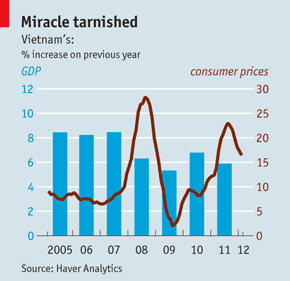
The most immediate concern is inflation, which last year rose to above 20% for the second time in three years (see chart). Vietnam now has Asia’s highest inflation rate, a fact that government censors have asked local journalists to stop reporting. Thousands of businesses have gone bankrupt, property prices have collapsed and banks and state-owned enterprises (SOEs) are riddled with bad debts.


The reversal has been sudden. Vietnam’s GDP increased by more than 8% a year from 2003 to 2007, when the country attracted a surge of foreign investment. Now the World Bank is predicting that growth will average 6% a year in the five-year period up to the end of 2012. McKinsey, a consultancy, argues that unless Vietnam boosts its labour productivity by more than half, growth is likely to dwindle to below 5%. That will be well short of the government’s target of 7-8%. As McKinsey argues, “the difference sounds small, but it isn’t.” By 2020, Vietnam’s economy could be almost a third smaller than it would have been had economy continued to grow at 7% a year.

Everyone, even communist leaders, agrees on the main reasons for the slowdown. The poorly run, corrupt and wasteful SOEs, which account for about 40% of output, weigh the economy down. The formula of low-wage, low-cost manufacturing no longer works as it once did. Countries such as Cambodia and Bangladesh now undercut Vietnam in cheap manufactures. Yet the country has failed to move up the value-chain into more productive activities and higher-tech goods.

Frustratingly, however, realising this and doing something about it seem to be two different things in the minds of Vietnam’s communist rulers. A few optimists were hoping for changes at a three-day meeting of senior party cadres last month. Alas, there was a lot of breast-beating and little else. Nguyen Phu Trong, the general secretary of the Communist Party, urged the party to reform if it wanted to avoid an existential threat. But although his speech was made public, the rest of the meeting—in time-honoured fashion—took place behind closed doors.

Calls by the party to reform or die are not new. “They’ve been saying that for 20 years,” says Carl Thayer, an expert on Vietnamese politics at the Australian Defence Force Academy in Canberra. What is missing, now as in the past, is any detailed plan about how to implement reforms such as restructuring the clunky state-owned sector, streamlining public investment and improving transparency. Nine executives from Vinashin, a debt-ridden state-owned shipbuilder, went on trial on March 27th charged with mismanaging state resources. It is the biggest case of its kind for several years, but the politicians who encouraged and financed the company’s grandiose expansion, including the prime minister, are not likely to be held to account.

Even if there were a change of mind at the top, it would still be difficult for leaders to implement change throughout the system. Power in Vietnam is more dispersed than in neighbouring China, and vested interests in business and politics are bigger obstacles to change. Moreover, whereas China’s Communist Party has had some success in reinventing itself as an Ivy League-style networking club for the elite, its comrades in Vietnam appear stuck in the past. The legitimacy won by military victories more than a generation ago is fading into distant memory, and Vietnamese leaders’ claim to economic competence is increasingly difficult to sustain.

Thứ Tư, 28 tháng 3, 2012

The Real Leadership Lessons of Steve Jobs

The Real Leadership Lessons of Steve Jobs
by Walter Isaacson
His saga is the entrepreneurial creation myth writ large: Steve Jobs cofounded Apple in his parents’ garage in 1976, was ousted in 1985, returned to rescue it from near bankruptcy in 1997, and by the time he died, in October 2011, had built it into the world’s most valuable company. Along the way he helped to transform seven industries: personal computing, animated movies, music, phones, tablet computing, retail stores, and digital publishing. He thus belongs in the pantheon of America’s great innovators, along with Thomas Edison, Henry Ford, and Walt Disney. None of these men was a saint, but long after their personalities are forgotten, history will remember how they applied imagination to technology and business.
In the months since my biography of Jobs came out, countless commentators have tried to draw management lessons from it. Some of those readers have been insightful, but I think that many of them (especially those with no experience in entrepreneurship) fixate too much on the rough edges of his personality. The essence of Jobs, I think, is that his personality was integral to his way of doing business. He acted as if the normal rules didn’t apply to him, and the passion, intensity, and extreme emotionalism he brought to everyday life were things he also poured into the products he made. His petulance and impatience were part and parcel of his perfectionism.
One of the last times I saw him, after I had finished writing most of the book, I asked him again about his tendency to be rough on people. “Look at the results,” he replied. “These are all smart people I work with, and any of them could get a top job at another place if they were truly feeling brutalized. But they don’t.” Then he paused for a few moments and said, almost wistfully, “And we got some amazing things done.” Indeed, he and Apple had had a string of hits over the past dozen years that was greater than that of any other innovative company in modern times: iMac, iPod, iPod nano, iTunes Store, Apple Stores, MacBook, iPhone, iPad, App Store, OS X Lion—not to mention every Pixar film. And as he battled his final illness, Jobs was surrounded by an intensely loyal cadre of colleagues who had been inspired by him for years and a very loving wife, sister, and four children.
So I think the real lessons from Steve Jobs have to be drawn from looking at what he actually accomplished. I once asked him what he thought was his most important creation, thinking he would answer the iPad or the Macintosh. Instead he said it was Apple the company. Making an enduring company, he said, was both far harder and more important than making a great product. How did he do it? Business schools will be studying that question a century from now. Here are what I consider the keys to his success.
Focus
When Jobs returned to Apple in 1997, it was producing a random array of computers and peripherals, including a dozen different versions of the Macintosh. After a few weeks of product review sessions, he’d finally had enough. “Stop!” he shouted. “This is crazy.” He grabbed a Magic Marker, padded in his bare feet to a whiteboard, and drew a two-by-two grid. “Here’s what we need,” he declared. Atop the two columns, he wrote “Consumer” and “Pro.” He labeled the two rows “Desktop” and “Portable.” Their job, he told his team members, was to focus on four great products, one for each quadrant. All other products should be canceled. There was a stunned silence. But by getting Apple to focus on making just four computers, he saved the company. “Deciding what not to do is as important as deciding what to do,” he told me. “That’s true for companies, and it’s true for products.”
After he righted the company, Jobs began taking his “top 100” people on a retreat each year. On the last day, he would stand in front of a whiteboard (he loved whiteboards, because they gave him complete control of a situation and they engendered focus) and ask, “What are the 10 things we should be doing next?” People would fight to get their suggestions on the list. Jobs would write them down—and then cross off the ones he decreed dumb. After much jockeying, the group would come up with a list of 10. Then Jobs would slash the bottom seven and announce, “We can only do three.”
Focus was ingrained in Jobs’s personality and had been honed by his Zen training. He relentlessly filtered out what he considered distractions. Colleagues and family members would at times be exasperated as they tried to get him to deal with issues—a legal problem, a medical diagnosis—they considered important. But he would give a cold stare and refuse to shift his laserlike focus until he was ready.
Near the end of his life, Jobs was visited at home by Larry Page, who was about to resume control of Google, the company he had cofounded. Even though their companies were feuding, Jobs was willing to give some advice. “The main thing I stressed was focus,” he recalled. Figure out what Google wants to be when it grows up, he told Page. “It’s now all over the map. What are the five products you want to focus on? Get rid of the rest, because they’re dragging you down. They’re turning you into Microsoft. They’re causing you to turn out products that are adequate but not great.” Page followed the advice. In January 2012 he told employees to focus on just a few priorities, such as Android and Google+, and to make them “beautiful,” the way Jobs would have done.
Simplify
Jobs’s Zenlike ability to focus was accompanied by the related instinct to simplify things by zeroing in on their essence and eliminating unnecessary components. “Simplicity is the ultimate sophistication,” declared Apple’s first marketing brochure. To see what that means, compare any Apple software with, say, Microsoft Word, which keeps getting uglier and more cluttered with nonintuitive navigational ribbons and intrusive features. It is a reminder of the glory of Apple’s quest for simplicity.
Jobs learned to admire simplicity when he was working the night shift at Atari as a college dropout. Atari’s games came with no manual and needed to be uncomplicated enough that a stoned freshman could figure them out. The only instructions for its Star Trek game were: “1. Insert quarter. 2. Avoid Klingons.” His love of simplicity in design was refined at design conferences he attended at the Aspen Institute in the late 1970s on a campus built in the Bauhaus style, which emphasized clean lines and functional design devoid of frills or distractions.
When Jobs visited Xerox’s Palo Alto Research Center and saw the plans for a computer that had a graphical user interface and a mouse, he set about making the design both more intuitive (his team enabled the user to drag and drop documents and folders on a virtual desktop) and simpler. For example, the Xerox mouse had three buttons and cost $300; Jobs went to a local industrial design firm and told one of its founders, Dean Hovey, that he wanted a simple, single-button model that cost $15. Hovey complied.
Jobs aimed for the simplicity that comes from conquering, rather than merely ignoring, complexity. Achieving this depth of simplicity, he realized, would produce a machine that felt as if it deferred to users in a friendly way, rather than challenging them. “It takes a lot of hard work,” he said, “to make something simple, to truly understand the underlying challenges and come up with elegant solutions.”
In Jony Ive, Apple’s industrial designer, Jobs met his soul mate in the quest for deep rather than superficial simplicity. They knew that simplicity is not merely a minimalist style or the removal of clutter. In order to eliminate screws, buttons, or excess navigational screens, it was necessary to understand profoundly the role each element played. “To be truly simple, you have to go really deep,” Ive explained. “For example, to have no screws on something, you can end up having a product that is so convoluted and so complex. The better way is to go deeper with the simplicity, to understand everything about it and how it’s manufactured.”
During the design of the iPod interface, Jobs tried at every meeting to find ways to cut clutter. He insisted on being able to get to whatever he wanted in three clicks. One navigation screen, for example, asked users whether they wanted to search by song, album, or artist. “Why do we need that screen?” Jobs demanded. The designers realized they didn’t. “There would be times when we’d rack our brains on a user interface problem, and he would go, ‘Did you think of this?’” says Tony Fadell, who led the iPod team. “And then we’d all go, ‘Holy shit.’ He’d redefine the problem or approach, and our little problem would go away.” At one point Jobs made the simplest of all suggestions: Let’s get rid of the on/off button. At first the team members were taken aback, but then they realized the button was unnecessary. The device would gradually power down if it wasn’t being used and would spring to life when reengaged.
Likewise, when Jobs was shown a cluttered set of proposed navigation screens for iDVD, which allowed users to burn video onto a disk, he jumped up and drew a simple rectangle on a whiteboard. “Here’s the new application,” he said. “It’s got one window. You drag your video into the window. Then you click the button that says ‘Burn.’ That’s it. That’s what we’re going to make.”
In looking for industries or categories ripe for disruption, Jobs always asked who was making products more complicated than they should be. In 2001 portable music players and ways to acquire songs online fit that description, leading to the iPod and the iTunes Store. Mobile phones were next. Jobs would grab a phone at a meeting and rant (correctly) that nobody could possibly figure out how to navigate half the features, including the address book. At the end of his career he was setting his sights on the television industry, which had made it almost impossible for people to click on a simple device to watch what they wanted when they wanted.
Take Responsibility End to End
Jobs knew that the best way to achieve simplicity was to make sure that hardware, software, and peripheral devices were seamlessly integrated. An Apple ecosystem—an iPod connected to a Mac with iTunes software, for example—allowed devices to be simpler, syncing to be smoother, and glitches to be rarer. The more complex tasks, such as making new playlists, could be done on the computer, allowing the iPod to have fewer functions and buttons.
Jobs and Apple took end-to-end responsibility for the user experience—something too few companies do. From the performance of the ARM microprocessor in the iPhone to the act of buying that phone in an Apple Store, every aspect of the customer experience was tightly linked together. Both Microsoft in the 1980s and Google in the past few years have taken a more open approach that allows their operating systems and software to be used by various hardware manufacturers. That has sometimes proved the better business model. But Jobs fervently believed that it was a recipe for (to use his technical term) crappier products. “People are busy,” he said. “They have other things to do than think about how to integrate their computers and devices.”
Part of Jobs’s compulsion to take responsibility for what he called “the whole widget” stemmed from his personality, which was very controlling. But it was also driven by his passion for perfection and making elegant products. He got hives, or worse, when contemplating the use of great Apple software on another company’s uninspired hardware, and he was equally allergic to the thought that unapproved apps or content might pollute the perfection of an Apple device. It was an approach that did not always maximize short-term profits, but in a world filled with junky devices, inscrutable error messages, and annoying interfaces, it led to astonishing products marked by delightful user experiences. Being in the Apple ecosystem could be as sublime as walking in one of the Zen gardens of Kyoto that Jobs loved, and neither experience was created by worshipping at the altar of openness or by letting a thousand flowers bloom. Sometimes it’s nice to be in the hands of a control freak.
When Behind, Leapfrog
The mark of an innovative company is not only that it comes up with new ideas first. It also knows how to leapfrog when it finds itself behind. That happened when Jobs built the original iMac. He focused on making it useful for managing a user’s photos and videos, but it was left behind when dealing with music. People with PCs were downloading and swapping music and then ripping and burning their own CDs. The iMac’s slot drive couldn’t burn CDs. “I felt like a dope,” he said. “I thought we had missed it.”
But instead of merely catching up by upgrading the iMac’s CD drive, he decided to create an integrated system that would transform the music industry. The result was the combination of iTunes, the iTunes Store, and the iPod, which allowed users to buy, share, manage, store, and play music better than they could with any other devices.
After the iPod became a huge success, Jobs spent little time relishing it. Instead he began to worry about what might endanger it. One possibility was that mobile phone makers would start adding music players to their handsets. So he cannibalized iPod sales by creating the iPhone. “If we don’t cannibalize ourselves, someone else will,” he said.
Put Products Before Profits
When Jobs and his small team designed the original Macintosh, in the early 1980s, his injunction was to make it “insanely great.” He never spoke of profit maximization or cost trade-offs. “Don’t worry about price, just specify the computer’s abilities,” he told the original team leader. At his first retreat with the Macintosh team, he began by writing a maxim on his whiteboard: “Don’t compromise.” The machine that resulted cost too much and led to Jobs’s ouster from Apple. But the Macintosh also “put a dent in the universe,” as he said, by accelerating the home computer revolution. And in the long run he got the balance right: Focus on making the product great and the profits will follow.
John Sculley, who ran Apple from 1983 to 1993, was a marketing and sales executive from Pepsi. He focused more on profit maximization than on product design after Jobs left, and Apple gradually declined. “I have my own theory about why decline happens at companies,” Jobs told me: They make some great products, but then the sales and marketing people take over the company, because they are the ones who can juice up profits. “When the sales guys run the company, the product guys don’t matter so much, and a lot of them just turn off. It happened at Apple when Sculley came in, which was my fault, and it happened when Ballmer took over at Microsoft.”
When Jobs returned, he shifted Apple’s focus back to making innovative products: the sprightly iMac, the PowerBook, and then the iPod, the iPhone, and the iPad. As he explained, “My passion has been to build an enduring company where people were motivated to make great products. Everything else was secondary. Sure, it was great to make a profit, because that was what allowed you to make great products. But the products, not the profits, were the motivation. Sculley flipped these priorities to where the goal was to make money. It’s a subtle difference, but it ends up meaning everything—the people you hire, who gets promoted, what you discuss in meetings.”
Don’t Be a Slave To Focus Groups
When Jobs took his original Macintosh team on its first retreat, one member asked whether they should do some market research to see what customers wanted. “No,” Jobs replied, “because customers don’t know what they want until we’ve shown them.” He invoked Henry Ford’s line “If I’d asked customers what they wanted, they would have told me, ‘A faster horse!’”
Caring deeply about what customers want is much different from continually asking them what they want; it requires intuition and instinct about desires that have not yet formed. “Our task is to read things that are not yet on the page,” Jobs explained. Instead of relying on market research, he honed his version of empathy—an intimate intuition about the desires of his customers. He developed his appreciation for intuition—feelings that are based on accumulated experiential wisdom—while he was studying Buddhism in India as a college dropout. “The people in the Indian countryside don’t use their intellect like we do; they use their intuition instead,” he recalled. “Intuition is a very powerful thing—more powerful than intellect, in my opinion.”
Sometimes that meant that Jobs used a one-person focus group: himself. He made products that he and his friends wanted. For example, there were many portable music players around in 2000, but Jobs felt they were all lame, and as a music fanatic he wanted a simple device that would allow him to carry a thousand songs in his pocket. “We made the iPod for ourselves,” he said, “and when you’re doing something for yourself, or your best friend or family, you’re not going to cheese out.”
Bend Reality
Jobs’s (in)famous ability to push people to do the impossible was dubbed by colleagues his Reality Distortion Field, after an episode of Star Trek in which aliens create a convincing alternative reality through sheer mental force. An early example was when Jobs was on the night shift at Atari and pushed Steve Wozniak to create a game called Breakout. Woz said it would take months, but Jobs stared at him and insisted he could do it in four days. Woz knew that was impossible, but he ended up doing it.
Those who did not know Jobs interpreted the Reality Distortion Field as a euphemism for bullying and lying. But those who worked with him admitted that the trait, infuriating as it might be, led them to perform extraordinary feats. Because Jobs felt that life’s ordinary rules didn’t apply to him, he could inspire his team to change the course of computer history with a small fraction of the resources that Xerox or IBM had. “It was a self-fulfilling distortion,” recalls Debi Coleman, a member of the original Mac team who won an award one year for being the employee who best stood up to Jobs. “You did the impossible because you didn’t realize it was impossible.”
One day Jobs marched into the cubicle of Larry Kenyon, the engineer who was working on the Macintosh operating system, and complained that it was taking too long to boot up. Kenyon started to explain why reducing the boot-up time wasn’t possible, but Jobs cut him off. “If it would save a person’s life, could you find a way to shave 10 seconds off the boot time?” he asked. Kenyon allowed that he probably could. Jobs went to a whiteboard and showed that if five million people were using the Mac and it took 10 seconds extra to turn it on every day, that added up to 300 million or so hours a year—the equivalent of at least 100 lifetimes a year. After a few weeks Kenyon had the machine booting up 28 seconds faster.
When Jobs was designing the iPhone, he decided that he wanted its face to be a tough, scratchproof glass, rather than plastic. He met with Wendell Weeks, the CEO of Corning, who told him that Corning had developed a chemical exchange process in the 1960s that led to what it dubbed “Gorilla glass.” Jobs replied that he wanted a major shipment of Gorilla glass in six months. Weeks said that Corning was not making the glass and didn’t have that capacity. “Don’t be afraid,” Jobs replied. This stunned Weeks, who was unfamiliar with Jobs’s Reality Distortion Field. He tried to explain that a false sense of confidence would not overcome engineering challenges, but Jobs had repeatedly shown that he didn’t accept that premise. He stared unblinking at Weeks. “Yes, you can do it,” he said. “Get your mind around it. You can do it.” Weeks recalls that he shook his head in astonishment and then called the managers of Corning’s facility in Harrodsburg, Kentucky, which had been making LCD displays, and told them to convert immediately to making Gorilla glass full-time. “We did it in under six months,” he says. “We put our best scientists and engineers on it, and we just made it work.” As a result, every piece of glass on an iPhone or an iPad is made in America by Corning.
Impute
Jobs’s early mentor Mike Markkula wrote him a memo in 1979 that urged three principles. The first two were “empathy” and “focus.” The third was an awkward word, “impute,” but it became one of Jobs’s key doctrines. He knew that people form an opinion about a product or a company on the basis of how it is presented and packaged. “Mike taught me that people do judge a book by its cover,” he told me.
When he was getting ready to ship the Macintosh in 1984, he obsessed over the colors and design of the box. Similarly, he personally spent time designing and redesigning the jewellike boxes that cradle the iPod and the iPhone and listed himself on the patents for them. He and Ive believed that unpacking was a ritual like theater and heralded the glory of the product. “When you open the box of an iPhone or iPad, we want that tactile experience to set the tone for how you perceive the product,” Jobs said.
Sometimes Jobs used the design of a machine to “impute” a signal rather than to be merely functional. For example, when he was creating the new and playful iMac, after his return to Apple, he was shown a design by Ive that had a little recessed handle nestled in the top. It was more semiotic than useful. This was a desktop computer. Not many people were really going to carry it around. But Jobs and Ive realized that a lot of people were still intimidated by computers. If it had a handle, the new machine would seem friendly, deferential, and at one’s service. The handle signaled permission to touch the iMac. The manufacturing team was opposed to the extra cost, but Jobs simply announced, “No, we’re doing this.” He didn’t even try to explain.
Push for Perfection
During the development of almost every product he ever created, Jobs at a certain point “hit the pause button” and went back to the drawing board because he felt it wasn’t perfect. That happened even with the movie Toy Story. After Jeff Katzenberg and the team at Disney, which had bought the rights to the movie, pushed the Pixar team to make it edgier and darker, Jobs and the director, John Lasseter, finally stopped production and rewrote the story to make it friendlier. When he was about to launch Apple Stores, he and his store guru, Ron Johnson, suddenly decided to delay everything a few months so that the stores’ layouts could be reorganized around activities and not just product categories.
The same was true for the iPhone. The initial design had the glass screen set into an aluminum case. One Monday morning Jobs went over to see Ive. “I didn’t sleep last night,” he said, “because I realized that I just don’t love it.” Ive, to his dismay, instantly saw that Jobs was right. “I remember feeling absolutely embarrassed that he had to make the observation,” he says. The problem was that the iPhone should have been all about the display, but in its current design the case competed with the display instead of getting out of the way. The whole device felt too masculine, task-driven, efficient. “Guys, you’ve killed yourselves over this design for the last nine months, but we’re going to change it,” Jobs told Ive’s team. “We’re all going to have to work nights and weekends, and if you want, we can hand out some guns so you can kill us now.” Instead of balking, the team agreed. “It was one of my proudest moments at Apple,” Jobs recalled.
A similar thing happened as Jobs and Ive were finishing the iPad. At one point Jobs looked at the model and felt slightly dissatisfied. It didn’t seem casual and friendly enough to scoop up and whisk away. They needed to signal that you could grab it with one hand, on impulse. They decided that the bottom edge should be slightly rounded, so that a user would feel comfortable just snatching it up rather than lifting it carefully. That meant engineering had to design the necessary connection ports and buttons in a thin, simple lip that sloped away gently underneath. Jobs delayed the product until the change could be made.
Jobs’s perfectionism extended even to the parts unseen. As a young boy, he had helped his father build a fence around their backyard, and he was told they had to use just as much care on the back of the fence as on the front. “Nobody will ever know,” Steve said. His father replied, “But you will know.” A true craftsman uses a good piece of wood even for the back of a cabinet against the wall, his father explained, and they should do the same for the back of the fence. It was the mark of an artist to have such a passion for perfection. In overseeing the Apple II and the Macintosh, Jobs applied this lesson to the circuit board inside the machine. In both instances he sent the engineers back to make the chips line up neatly so the board would look nice. This seemed particularly odd to the engineers of the Macintosh, because Jobs had decreed that the machine be tightly sealed. “Nobody is going to see the PC board,” one of them protested. Jobs reacted as his father had: “I want it to be as beautiful as possible, even if it’s inside the box. A great carpenter isn’t going to use lousy wood for the back of a cabinet, even though nobody’s going to see it.” They were true artists, he said, and should act that way. And once the board was redesigned, he had the engineers and other members of the Macintosh team sign their names so that they could be engraved inside the case. “Real artists sign their work,” he said.
Tolerate Only “A” Players
Jobs was famously impatient, petulant, and tough with the people around him. But his treatment of people, though not laudable, emanated from his passion for perfection and his desire to work with only the best. It was his way of preventing what he called “the bozo explosion,” in which managers are so polite that mediocre people feel comfortable sticking around. “I don’t think I run roughshod over people,” he said, “but if something sucks, I tell people to their face. It’s my job to be honest.” When I pressed him on whether he could have gotten the same results while being nicer, he said perhaps so. “But it’s not who I am,” he said. “Maybe there’s a better way—a gentlemen’s club where we all wear ties and speak in this Brahmin language and velvet code words—but I don’t know that way, because I am middle-class from California.”
Was all his stormy and abusive behavior necessary? Probably not. There were other ways he could have motivated his team. “Steve’s contributions could have been made without so many stories about him terrorizing folks,” Apple’s cofounder, Wozniak, said. “I like being more patient and not having so many conflicts. I think a company can be a good family.” But then he added something that is undeniably true: “If the Macintosh project had been run my way, things probably would have been a mess.”
It’s important to appreciate that Jobs’s rudeness and roughness were accompanied by an ability to be inspirational. He infused Apple employees with an abiding passion to create groundbreaking products and a belief that they could accomplish what seemed impossible. And we have to judge him by the outcome. Jobs had a close-knit family, and so it was at Apple: His top players tended to stick around longer and be more loyal than those at other companies, including ones led by bosses who were kinder and gentler. CEOs who study Jobs and decide to emulate his roughness without understanding his ability to generate loyalty make a dangerous mistake.
“I’ve learned over the years that when you have really good people, you don’t have to baby them,” Jobs told me. “By expecting them to do great things, you can get them to do great things. Ask any member of that Mac team. They will tell you it was worth the pain.” Most of them do. “He would shout at a meeting, ‘You asshole, you never do anything right,’” Debi Coleman recalls. “Yet I consider myself the absolute luckiest person in the world to have worked with him.”
Engage Face-to-Face
Despite being a denizen of the digital world, or maybe because he knew all too well its potential to be isolating, Jobs was a strong believer in face-to-face meetings. “There’s a temptation in our networked age to think that ideas can be developed by e-mail and iChat,” he told me. “That’s crazy. Creativity comes from spontaneous meetings, from random discussions. You run into someone, you ask what they’re doing, you say ‘Wow,’ and soon you’re cooking up all sorts of ideas.”
He had the Pixar building designed to promote unplanned encounters and collaborations. “If a building doesn’t encourage that, you’ll lose a lot of innovation and the magic that’s sparked by serendipity,” he said. “So we designed the building to make people get out of their offices and mingle in the central atrium with people they might not otherwise see.” The front doors and main stairs and corridors all led to the atrium; the café and the mailboxes were there; the conference rooms had windows that looked out onto it; and the 600-seat theater and two smaller screening rooms all spilled into it. “Steve’s theory worked from day one,” Lasseter recalls. “I kept running into people I hadn’t seen for months. I’ve never seen a building that promoted collaboration and creativity as well as this one.”
Jobs hated formal presentations, but he loved freewheeling face-to-face meetings. He gathered his executive team every week to kick around ideas without a formal agenda, and he spent every Wednesday afternoon doing the same with his marketing and advertising team. Slide shows were banned. “I hate the way people use slide presentations instead of thinking,” Jobs recalled. “People would confront a problem by creating a presentation. I wanted them to engage, to hash things out at the table, rather than show a bunch of slides. People who know what they’re talking about don’t need PowerPoint.”
Know Both the Big Picture and the Details
Jobs’s passion was applied to issues both large and minuscule. Some CEOs are great at vision; others are managers who know that God is in the details. Jobs was both. Time Warner CEO Jeff Bewkes says that one of Jobs’s salient traits was his ability and desire to envision overarching strategy while also focusing on the tiniest aspects of design. For example, in 2000 he came up with the grand vision that the personal computer should become a “digital hub” for managing all of a user’s music, videos, photos, and content, and thus got Apple into the personal-device business with the iPod and then the iPad. In 2010 he came up with the successor strategy—the “hub” would move to the cloud—and Apple began building a huge server farm so that all a user’s content could be uploaded and then seamlessly synced to other personal devices. But even as he was laying out these grand visions, he was fretting over the shape and color of the screws inside the iMac.
Combine the Humanities with the Sciences
“I always thought of myself as a humanities person as a kid, but I liked electronics,” Jobs told me on the day he decided to cooperate on a biography. “Then I read something that one of my heroes, Edwin Land of Polaroid, said about the importance of people who could stand at the intersection of humanities and sciences, and I decided that’s what I wanted to do.” It was as if he was describing the theme of his life, and the more I studied him, the more I realized that this was, indeed, the essence of his tale.
He connected the humanities to the sciences, creativity to technology, arts to engineering. There were greater technologists (Wozniak, Gates), and certainly better designers and artists. But no one else in our era could better firewire together poetry and processors in a way that jolted innovation. And he did it with an intuitive feel for business strategy. At almost every product launch over the past decade, Jobs ended with a slide that showed a sign at the intersection of Liberal Arts and Technology Streets.
The creativity that can occur when a feel for both the humanities and the sciences exists in one strong personality was what most interested me in my biographies of Franklin and Einstein, and I believe that it will be a key to building innovative economies in the 21st century. It is the essence of applied imagination, and it’s why both the humanities and the sciences are critical for any society that is to have a creative edge in the future.
Even when he was dying, Jobs set his sights on disrupting more industries. He had a vision for turning textbooks into artistic creations that anyone with a Mac could fashion and craft—something that Apple announced in January 2012. He also dreamed of producing magical tools for digital photography and ways to make television simple and personal. Those, no doubt, will come as well. And even though he will not be around to see them to fruition, his rules for success helped him build a company that not only will create these and other disruptive products, but will stand at the intersection of creativity and technology as long as Jobs’s DNA persists at its core.
Stay Hungry, Stay Foolish
Steve Jobs was a product of the two great social movements that emanated from the San Francisco Bay Area in the late 1960s. The first was the counterculture of hippies and antiwar activists, which was marked by psychedelic drugs, rock music, and antiauthoritarianism. The second was the high-tech and hacker culture of Silicon Valley, filled with engineers, geeks, wireheads, phreakers, cyberpunks, hobbyists, and garage entrepreneurs. Overlying both were various paths to personal enlightenment—Zen and Hinduism, meditation and yoga, primal scream therapy and sensory deprivation, Esalen and est.
An admixture of these cultures was found in publications such as Stewart Brand’s Whole Earth Catalog. On its first cover was the famous picture of Earth taken from space, and its subtitle was “access to tools.” The underlying philosophy was that technology could be our friend. Jobs—who became a hippie, a rebel, a spiritual seeker, a phone phreaker, and an electronic hobbyist all wrapped into one—was a fan. He was particularly taken by the final issue, which came out in 1971, when he was still in high school. He took it with him to college and then to the apple farm commune where he lived after dropping out. He later recalled: “On the back cover of their final issue was a photograph of an early morning country road, the kind you might find yourself hitchhiking on if you were so adventurous. Beneath it were the words: ‘Stay Hungry. Stay Foolish.’” Jobs stayed hungry and foolish throughout his career by making sure that the business and engineering aspect of his personality was always complemented by a hippie nonconformist side from his days as an artistic, acid-dropping, enlightenment-seeking rebel. In every aspect of his life—the women he dated, the way he dealt with his cancer diagnosis, the way he ran his business—his behavior reflected the contradictions, confluence, and eventual synthesis of all these varying strands.
Even as Apple became corporate, Jobs asserted his rebel and counterculture streak in its ads, as if to proclaim that he was still a hacker and a hippie at heart. The famous “1984” ad showed a renegade woman outrunning the thought police to sling a sledgehammer at the screen of an Orwellian Big Brother. And when he returned to Apple, Jobs helped write the text for the “Think Different” ads: “Here’s to the crazy ones. The misfits. The rebels. The troublemakers. The round pegs in the square holes…” If there was any doubt that, consciously or not, he was describing himself, he dispelled it with the last lines: “While some see them as the crazy ones, we see genius. Because the people who are crazy enough to think they can change the world are the ones who do.”
--------------------------------
Walter Isaacson, the CEO of the Aspen Institute, is the author of Steve Jobs and of biographies of Henry Kissinger, Benjamin Franklin, and Albert Einstein.

Thứ Ba, 27 tháng 3, 2012

Reading: Niger Public Expenditure Tracking Survey

Source: W0rldbank Document, December 21 2008

1. Objective and Methodology of The Niger Public Expenditure Tracking Survey (PETS)

1.1 Motivation and objectives
- The significant inefficiencies in public sector delivery of services
- Expenditure procedures lack reliable mechanisms for tracking and monitoring. It is not sure whether resources always reach to the intended beneficiaries.
- Identifying potential failures in public service delivery mechanism.
The PETS focuses on identifying the inefficiencies and delays in public spending execution in the education and health sectors in Niger.
2. Background on Niger's education and health sectors
- Niger is one of the poorest countries in the world
- Poverty Reduction Strategy in 2007 with three key pillars: 1) economic growth; 2) poverty eradication; 3) access to basic services --> education and health are essential
- Problems proven by data:
+ the highest spending per studen as a percentage of GDP per capita but the lowest lowest primary enrollment rate and the lowest completion rate.
+ Lowest spending rates for health. Lack of drugs, materials and personnel has resulted in persistent difficulties with access and quality of health services
3. Methodology
- The general methodology of a PETS is intuitively simple, consisting of charting budget flows and release mechanisms (funds and materials) through various government agencies and facilities. The in- and out-financial and material flows are compared (ideally reconciled) at each of the consecutive nodes of the observed spending channels that correspond to the specific resource distribution mechanisms. This is often referred to as vertical tracking.
- PETS is not an audit. It only identity the bottlenecks, resource discrepancies and delays occur in the distribution channels and whenever possible, makes recommendation on how to improve the systems to reduce these inefficiencies.
4 Sampling

The PETS sample design was regionally, but not nationally representative.
5. Implementation of PETS
The criteria for selecting expenditures for tracking were twofold: (i) the spending chain should be sufficiently important in terms of the proportion of the budget; and (ii) the chain should be sufficiently representative of the distribution mechanisms to warrant tracking. More precisely, the PETS tracks selected resource flows, both financial and materials, that account for a significant proportion of the sectors’ recurrent non-salary spending or that go through expenditure execution procedures/agencies which are prone to leakages, waste and delays.
Education: textbooks and notebooks in primary schools
Health: patient food expenditures, hospital supplies, essential medicines
6. Tracking textbooks, notebooks and drawing books in primary schools
- Record keeping in the education sector is a problem preventing greater transparency and potentially facilitating divergence of resources.
- despite all the apparent inefficiencies in the resource distribution systems, schools in the three regions surveyed manage to ensure that most students had access to textbooks by sharing books between two or three students and probably also by using used books
7. Tracking patients' food expenditures and hospital supplies
- The financial resource flows between the MEF and the MSP reveals three issues relevant to the PETS: accuracy of record keeping; delays; and discrepancies.
- There are significant discrepancies in financial flow records between the MSP and the district health offices. The quality of records at the district level is rather questionable, with frequent occurrences of implausible figures.
- The inequality of resource distribution was evident among different districts but the reasons behind these inequalities cannot be determined by the PETS itself.
First, the shorter the distribution channels are, the less likely the leakages. Second, the better the quality of records between two nodes, the less likely the leakages.

Chủ Nhật, 31 tháng 10, 2010

Áp dụng triệt để nguyên tắc “ngân sách cứng”

http://sgtt.vn/Ban-doc/132056/Ap-dung-triet-de-nguyen-tac-%E2%80%9Cngan-sach-cung%E2%80%9D.html

SGTT.VN - Cho đến nay, cải cách doanh nghiệp nhà nước (DNNN) ở nước ta chưa thành công hoặc ít thành công nhất so với các nội dung cải cách khác. Điều đó đã và đang làm giảm mức độ thành công của cải cách và phát triển kinh tế. Sài Gòn Tiếp Thị giới thiệu bài viết của TS Nguyễn Đình Cung ở viện Nghiên cứu quản lý kinh tế Trung ương về một số giải pháp cần thực hiện ít nhất trong 5 năm 2011 – 2015 để tiếp tục đổi mới, nâng cao năng suất, hiệu quả và năng lực cạnh tranh của các DNNN.

Nguyên nhân chưa thành công, cơ bản không phải là do sở hữu – “cha chung không ai khóc” mà do cách thức, thể chế và công cụ thực hiện quyền chủ sở hữu nhà nước không phù hợp. Thứ đến, tuy nền kinh tế đã chuyển sang cơ chế thị trường nhưng DNNN chưa thực sự hoạt động theo cơ chế thị trường. Các DNNN, những người quản lý DNNN và một số người có liên quan đã tận dụng được những điểm lợi về tính tự phát của thị trường mà chưa bị chi phối, điều tiết bởi các quy luật của thị trường, nhất là chưa bị đối mặt với nguy cơ bị trừng phạt bởi các quy luật đó và hệ thống trách nhiệm giải trình trong các DNNN rất yếu, thậm chí chưa có. Thứ đến nữa, tuy nền kinh tế đã hội nhập, nhưng đa số các DNNN vẫn chưa thực sự hội nhập, chưa có tầm nhìn, tư duy toàn cầu, chưa đối mặt với cạnh tranh toàn cầu để tìm kiếm thị trường, huy động vốn, nhân lực, công nghệ, nhất là về quản trị.

Giải pháp cụ thể đầu tiên: ngân sách cứng

Định hướng cải cách, cơ cấu lại DNNN trong năm năm tới đây nên tập trung vào việc thực hiện đầy đủ và triệt để các nguyên tắc và cơ chế thị trường đối với DNNN và hoàn thiện khung quản trị DNNN theo các nguyên tắc và chuẩn quốc tế, áp dụng thống nhất.

Giải pháp cụ thể đầu tiên là áp dụng triệt để nguyên tắc “ngân sách cứng, tức là xoá bỏ những hình thức còn sót lại của “hạn chế ngân sách mềm” hiện nay.

Theo đó, cần xoá bỏ chế độ, hình thức cho vay, cấp tín dụng theo chỉ đạo, theo chỉ định của cơ quan quản lý nhà nước có thẩm quyền. Cũng như các doanh nghiệp khác, khả năng tiếp cận các nguồn tín dụng của DNNN cũng phải dựa trên tình hình tài chính lành mạnh, dự án đầu tư tốt, và thực tiễn quản trị tốt.

Trên cơ sở kết quả kiểm kê tài sản cố định của DNNN nói chung và từng DNNN nói riêng, cần thực hiện tính đúng, tính đủ chi phí đối với các DNNN theo giá thị trường (đất đai, tài nguyên khác, các tài sản cố định chưa được điều chỉnh hay đánh giá lại giá trị…)

Trong năm năm tới đây nên tập trung vào việc thực hiện đầy đủ và triệt để các nguyên tắc, cơ chế thị trường và hoàn thiện khung quản trị theo chuẩn quốc tế.

Đồng thời, cần tuyên bố chính sách và cam kết rõ ràng, từ nay trở đi, Chính phủ sẽ không ra các quyết định “khoanh nợ, giãn nợ”, không trả nợ – xử lý nợ thay, doanh nghiệp phải tự vay – tự trả theo quan hệ kinh tế – dân sự giữa chủ nợ và con nợ. Nếu sắp tới không may có doanh nghiệp rơi vào tình trạng mất khả năng thanh toán thì phải để doanh nghiệp và chủ nợ tự cơ cấu lại hoặc để cho phá sản.

Ngoài ra, cần xem xét trên thực tế các hình thức, biểu hiện đặc quyền, đặc lợi còn tồn tại và hạn chế đến mức tối đa chúng, nhất là quyền kinh doanh; tiếp cận đất đai, tài nguyên khác; tiếp cận thông tin, nhất là thông tin về các loại quy hoạch; tiếp cận các nhà hoạch định chính sách.

Cuối cùng, tiếp tục mở cửa thị trường trong các ngành còn độc quyền doanh nghiệp, mở cửa thị trường điện theo phương án của bộ Công thương.

Làm gì và không làm gì?

Giải pháp thứ hai là xác định rõ, cụ thể và nhất quán mục tiêu của DNNN nói chung là công cụ thực hiện chính sách công nghiệp hoá, chuyển đổi cơ cấu kinh tế lên thang bậc phát triển cao hơn, giá trị gia tăng lớn hơn. Đó là vì khu vực kinh tế tư nhân trong nước còn quá nhỏ, quá yếu và công nghiệp hoá không thể và không nên dựa nhiều vào FDI. Tuy nhiên, mục tiêu nói trên phải đạt được theo cơ chế thị trường.

Như vậy, sẽ không giao và không sử dụng DNNN là công cụ ổn định kinh tế vĩ mô nữa, không sử dụng DNNN điều tiết thị trường, để thực hiện các nhiệm vụ xã hội. Các trách nhiệm nói trên của DNNN nằm trong khuôn khổ pháp luật chung, giống như các doanh nghiệp thuộc các thành phần kinh tế khác.

Việc cần làm là xác định lại vị trí của từng tập đoàn, tổng công ty trong từng ngành cụ thể. Sau đó, tuỳ từng trường hợp cụ thể, giao cho chúng sứ mệnh là trong 10 – 15 năm tới phải phát triển, trở thành một trong số các doanh nghiệp hàng đầu của khu vực Đông Nam Á hoặc châu Á. Chỉ có như thế thì không gian phát triển kinh tế của nước ta mới được mở rộng. Đó cũng chính là một trong các cách chủ động hội nhập kinh tế quốc tế.

Về mục tiêu cụ thể hàng năm, ngoài tỷ suất lợi nhuận/vốn chủ sở hữu, nhà nước trong vai trò là chủ sở hữu còn xác định và giao cho tập đoàn, tổng công ty các mục tiêu cụ thể, bao gồm: doanh thu xuất khẩu, mức độ và trình độ phát triển công nghệ trong một thời hạn nhất định, năng lực nghiên cứu và phát triển công nghệ, đổi mới công nghệ, vị thế hay thị phần trên thị trường khu vực và thế giới… Đồng thời, thực hiện đánh giá việc thực hiện các mục tiêu nói trên.

Đổi mới cơ chế thực hiện quyền chủ sở hữu

Thứ nhất, từng bước tách biệt chức năng thực hiện quyền chủ sở hữu nhà nước với chức năng quản lý hành chính nhà nước của các bộ, uỷ ban nhân dân cấp tỉnh, tiến tới thành lập cơ quan cấp bộ chuyên trách thực hiện quyền chủ sở hữu và thực hiện quyền chủ sở hữu đó một cách chuyên nghiệp, tập trung và thống nhất (tham khảo mô hình SASACs ở Trung Quốc hay các bộ chuyên trách quản lý tài sản sở hữu nhà nước ở một số quốc gia khác).

Thứ hai, thiết lập hệ thống thông tin giám sát và quản lý doanh nghiệp, gồm thông tin về tài chính, thông tin về hoạt động kinh doanh, thông tin về các rủi ro và biến động bất thường liên quan.

Thứ ba, thực hiện công khai hoá và minh bạch hoá thông tin đối với các tập đoàn, tổng công ty nhà nước theo chuẩn mực đang áp dụng cho các công ty niêm yết trên thị trường chứng khoán Việt Nam. Cơ quan chủ sở hữu phải kiểm soát, giám sát việc công bố thông tin đảm bảo thông tin được công bố đầy đủ và kịp thời. Người đại diện theo pháp luật phải chịu trách nhiệm về tính chính xác, trung thực.

Thứ tư, xây dựng bộ quy tắc quản trị theo các nguyên tắc và chuẩn mực quốc tế để áp dụng cho các công ty có sở hữu nhà nước, các công ty có sở hữu nhà nước trên 50%.

Thứ năm, đưa ra yêu cầu bắt buộc và có lộ trình cụ thể thực hiện niêm yết một số tập đoàn, tổng công ty quan trọng trên thị trường chứng khoán quốc tế như Singapore, Hong Kong hay thậm chí là New York.

Thứ sáu, tiếp tục thực hiện chương trình cổ phần hoá có lựa chọn như đã định.

Để thực hiện được những việc này, trước mắt cần củng cố và tăng cường năng lực chuyên môn và thẩm quyền của ban đổi mới và phát triển doanh nghiệp, bổ sung thêm các chuyên gia thuộc loại hàng đầu về phân tích tài chính doanh nghiệp; phân tích thị trường; phân tích, đánh giá và thẩm định dự án đầu tư; chuyên gia về quản trị công ty, đảm bảo cơ quan này đủ năng lực, thẩm quyền tham mưu cho thủ tướng về thực hiện quyền chủ sở hữu nhà nước cũng như xây dựng hệ chính sách tổng hợp về cải cách DNNN. Không nên giao cho các bộ chuyên ngành việc này vì mỗi bộ chỉ chuyên về một số vấn đề và các bộ thường lo về quản lý hành chính nhà nước chứ không chuyên sâu các chức năng, nhiệm vụ, nghiệp vụ quản lý với vai trò là người đầu tư vốn.

TS Nguyễn Đình Cung

Cái lợi của việc công khai, minh bạch thông tin

Việc công khai hoá và minh bạch hoá thông tin đối các tập đoàn, tổng công ty nhà nước sẽ có một số điểm lợi:

– Buộc các tập đoàn, tổng công ty phải tập hợp, phân tích thông tin một cách có hệ thống, đầy đủ, chính xác, kịp thời, qua đó giúp công tác quản lý tốt hơn và nâng cao trách nhiệm giải trình của từng cán bộ quản lý có liên quan.

– Góp phần hình thành hệ thống thông tin quản lý xuyên suốt từ các doanh nghiệp đến cơ quan chủ sở hữu, giúp cơ quan này giám sát tốt hơn họat động của doanh nghiệp.

– Tạo điều kiện để dân chúng, chủ nợ, khách hàng, chuyên gia và các bên liên quan khác theo dõi, đánh giá và giám sát được các hoạt động của tập đoàn, tổng công ty nói chung và từng công ty trong tập đoàn nói riêng. Đây chính là giám sát của thị trường, mỗi bên có lợi ích liên quan thực hiện giám sát theo cách riêng của họ, làm cho giám sát này luôn hiệu quả, hiệu lực, giảm áp lực và gánh nặng giám sát cho cơ quan chủ sở hữu.
Thứ Tư, 29 tháng 9, 2010

'Ai cũng muốn làm bên Chính phủ để có quyền'

Cập nhật lúc 20:56, Thứ Hai, 13/09/2010 (GMT+7)
http://vietnamnet.vn/chinhtri/201009/Ai-cung-muon-lam-ben-Chinh-phu-de-co-quyen-935288/
"Các lãnh đạo Đảng, Nhà nước cũng phải làm theo luật. Không thể đồng chí A đồng ý cho tỉnh này vài tỷ, đồng chí B lại vài tỷ cho tỉnh kia" - Chủ tịch Hội đồng Dân tộc K’sor Phước.

Sáng 13/9, buổi họp đầu tiên của phiên họp thứ 34, Ủy ban Thường vụ Quốc hội (UBTVQH cho ý kiến về định mức phân bổ ngân sách nhà nước của các tỉnh, thành phố trực thuộc trung ương, các bộ và cơ quan trung ương trong 5 năm 2011 - 2015.

Dù chỉ làm chuyên viên...

Cả nửa đầu buổi sáng chỉ dành cho việc đọc báo cáo. Bộ trưởng Tài chính Vũ Văn Ninh đọc xong Tờ trình Xây dựng hệ thống định mức chi thường xuyên của NSNN năm 2011, lại đến Tờ trình về các nguyên tắc, tiêu chí và định mức phân bổ vốn đầu tư phát triển bằng nguồn vốn NSNN giai đoạn 2011 - 2015. Sau đó, đến báo cáo thẩm tra của Ủy ban Tài chính Ngân sách.
Thời gian còn lại không nhiều nên Phó Chủ tịch QH Nguyễn Đức Kiên đề nghị các ủy viên UBTVQH cho ý kiến tập trung vào một số chủ đề định trước, "để Chính phủ có thể tiếp thu và điều chỉnh ngay, còn bắt tay phẩn bổ dự toán chi cho các bộ ngành, địa phương cho năm 2011". Một vấn đề rất quan trọng, nhưng không biết do thời gian dành cho thảo luận không nhiều hay vì số lượng tài liệu quá lớn, nói như Phó Chủ tịch Kiên là "đọc hết các báo cáo chi tiết cũng đủ nhức đầu" mà có nhiều khoảng im lặng, chỉ vỏn vẹn 4 ĐB lên tiếng.

Điểm đồng thuận lớn nhất giữa các ý kiến là việc giảm bớt chương trình hỗ trợ có mục tiêu từ ngân sách nhà nước (60 chương trình) và chương trình mục tiêu quốc gia (15) vì "phân tán nguồn lực, hiệu quả đầu tư giảm sút". Chủ nhiệm UB Kinh tế Hà Văn Hiền đề nghị rà soát hiệu quả để "xem cái nào để lại, cái nào trung ương đầu tư, còn cái nào để địa phương đầu tư", Chủ nhiệm VPQH Trần Đình Đàn "phê" chính những chương trình này "tạo tùy tiện người có quyền phẩn bổ ngân sách".

Riêng Chủ nhiệm UB Pháp luật Nguyễn Văn Thuận thẳng thắn "chương trình mục tiêu quốc gia phản ánh lợi ích nhóm, lĩnh vực, bộ ngành nào cũng muốn có một cái" và đề xuất dừng lại tất cả, không quyết định chương trình mục tiêu nào mới nữa, cái nào đang dở thì làm cho nốt, còn từ nay, tất cả chuyển hóa thành phân bổ ngân sách hàng năm.

"Không thể để bộ ngành xây dựng tiêu chí riêng cho chương trình mục tiêu quốc gia như đề xuất của Chính phủ được. Bộ KH - ĐT chỉ tổng hợp tiêu chí của các bộ ngành khác thì sinh ra làm gì? Câu chuyện Vinashin cũng là do có quy chế hoạt động riêng do Thủ tướng quyết định, trái pháp luật mà đúng quy chế vẫn cứ làm, nghĩa là bất chấp pháp luật. Thủ tướng bận trăm công nghìn việc, làm sao theo dõi được hết", ông Thuận nói.

Tương tự, với nguồn vốn từ trái phiếu chính phủ, vốn ODA, ông Hà Văn Hiền đề nghị phải có tiêu chí rõ ràng trong việc phân bổ cho các tỉnh thành, "không thể cứ tỉnh nào làm dự án nhanh là được cấp, vì dự án như vậy thường rất sơ khai, khi có vốn về không thể thực hiện, không thể giải ngân". Còn ông Thuận lại nhấn mạnh "Quốc hội là cơ quan quyền lực, Chính phủ là cơ quan chấp hành", để khẳng định QH phải quyết định mọi phân bổ ngân sách hàng năm, và mọi nguồn thu - chi đều cần đưa qua ngân sách.

Ngay với quỹ dự phòng (đang chiếm 3 - 4% ngân sách các tỉnh), ông Thuận cũng đề nghị phải giảm đi, để phòng chống thiên tai thì để chung vào quỹ phòng chống thiên tai, chứ tách riêng thế này lại tạo cơ chế xin cho hàng năm, "khiến ai cũng muốn làm bên Chính phủ để có quyền, dù chỉ làm chuyên viên, chứ không chịu sang bên lập pháp", ông Thuận "cảm thán".

Tăng thu, tiết kiệm chi

Chủ tịch Hội đồng Dân tộc K’sor Phước còn mạnh dạn đề nghị không nên duy trì việc chi đột xuất theo chỉ đạo của lãnh đạo Đảng, Nhà nước, bởi "các lãnh đạo Đảng, Nhà nước cũng phải làm theo luật. Không thể đồng chí A đồng ý cho tỉnh này vài tỷ, đồng chí B lại vài tỷ cho tỉnh kia".
Các tiêu chí xây dựng định mức phân bổ ngân sách cũng được các ĐB mổ xẻ nhiều.

Chủ nhiệm UB Kinh tế Hà Văn Hiền đề nghị khi xác định định mức phải xét đến yếu tố trượt giá, trong tiêu chí phân bổ ngân sách cho các tỉnh phải có hệ số bổ sung riêng với các tỉnh vùng biên giới.

Là Chủ nhiệm UB Các vấn đề xã hội nên bà Trương Thị Mai băn khoăn nhiều về mục tiêu phân bổ ngân sách bởi giai đoạn 2011 - 2015 sẽ tăng trưởng kinh tế liên tục, trong khi chênh lệch giữa các vùng miền, giữa đô thị với nông thôn, giữa vùng trung tâm với vùng sâu, vùng xa ngày càng lớn.

Phát biểu kết thúc phiên thảo luận, Phó Chủ tịch QH Nguyễn Đức Kiên khẳng định tiêu chí phân bổ phải đảm bảo tính công khai, bình đẳng, nhưng phải tạo động lực và sự chủ động cho các địa phương, bộ ngành góp sức nhiều vào thu ngân sách, để các đơn vị khác phải phấn đấu tăng thu, tiết kiệm và sử dụng hiệu quả nguồn thu - chi.

"Những tỉnh có nguồn thu đóng góp cho Trung ương cũng cần có cơ chế khuyến khích, vì bỏ 1 đồng cho các tỉnh này thu được hàng nghìn đồng, khác với tỉnh bỏ một đồng, thu được vài hào".
13 tỉnh, thành phố có điều tiết ngân sách về trung ương, Hà Nội, Hải Phòng, Quảng Ninh, Vĩnh Phúc, Đà Nẵng, Khánh Hòa, TPHCM, Đồng Nai, Bình Dương, Bà Rịa - Vũng Tàu, Cần Thơ (như thời kỳ ổn định ngân sách 2007 - 2010) và 2 tỉnh mới là Bắc Ninh, Quảng Ngãi.

* Khánh Linh

Phân bổ ngân sách 2011-2015: Nước chảy chỗ trũng

15:20 (GMT+7) - Thứ Bảy, 11/9/2010

ANH QUÂN

Các tỉnh nghèo, nguồn thu thấp có thể sẽ bị giảm tỷ trọng trong phân bổ vốn đầu tư từ ngân sách

“Hôm qua tôi làm việc với Tp.HCM, họ đề nghị tính thêm điểm cho tiêu chí điều tiết về ngân sách trung ương. Mà cứ tăng 1% thì bằng 1.000 tỷ đồng đấy”, Thứ trưởng Bộ Tài chính Nguyễn Công Nghiệp nói bên lề kỳ họp thứ 21 của Ủy ban Tài chính - Ngân sách Quốc hội, như để giải thích cho việc bộ này khó xử thế nào với chênh lệch lớn trong định mức phân bổ ngân sách giữa các địa phương.

Trước phát biểu của ông Nghiệp ít phút, cuộc họp của Ủy ban Tài chính - Ngân sách Quốc hội (diễn ra trong hai ngày 9-10/9, thảo luận về tiêu chí và định mức phân bổ vốn đầu tư phát triển bằng nguồn ngân sách nhà nước giai đoạn 2011-2015) đã “phủ” đầy các kiến nghị nâng điểm cho tỉnh nghèo, tỉnh khó khăn, địa bàn biên giới, hải đảo…

Chênh lệch giữa các địa phương quá lớn

“Tỉnh nghèo mong phát triển, tỉnh giàu cũng muốn tăng trưởng tiếp, cái đó là đúng thôi, nhưng nên xem xét chênh lệch giữa các tỉnh”, đại biểu Quốc hội tỉnh Bình Thuận tham dự cuộc họp mở lời.

Theo dự thảo của Bộ Kế hoạch và Đầu tư, trong tổng số trên 10,5 nghìn điểm được chấm cho 63 tỉnh, thành phố trong cả nước, tiêu chí trình độ phát triển chiếm gần 7 nghìn điểm, nhưng “chẻ” nhỏ nữa thì tiêu chí tỷ lệ hộ nghèo chỉ có hơn 200 điểm, còn lại đa phần là tỷ lệ điều tiết về ngân sách trung ương và thu nội địa.

Như vậy, với những tỉnh có số thu nội địa cao (không bao gồm thu từ sử dụng đất) và có điều tiết một phần thu ngân sách về trung ương đương nhiên sẽ được hưởng tỷ lệ vốn đầu tư phát triển từ ngân sách nhà nước lớn hơn.

Biểu tổng hợp về vấn đề này của Bộ Kế hoạch và Đầu tư cho thấy, có tới 21 tỉnh, thành phố chỉ chiếm tỷ trọng từ 0,5% trở xuống (mức thấp nhất là Ninh Thuận chỉ chiếm 0,3%) trong tổng số điểm trên 10,5 nghìn kể trên, được hiểu cũng sẽ chiếm tỷ trọng tương ứng trong vốn đầu tư phát triển trong suốt thời kỳ 5 năm tới.

Trong khi đó, một số tỉnh có số điểm và tỷ trọng rất cao so với phần còn lại, ví dụ như Tp.HCM đạt trên 2,3 nghìn điểm và có tỷ trọng tới 22,2% trong tổng điểm; Hà Nội xếp thứ hai với trên 1,6 nghìn điểm và chiếm tỷ trọng 15,7%...

Tỷ trọng trong phân bổ vốn đầu tư phát triển của hai thành phố kể trên thậm chí còn cao hơn của khu vực miền núi phía Bắc (7,6% tổng điểm); Bắc Trung bộ và duyên hải miền Trung (13,5%); Tây Nguyên (3,6%); đồng bằng sông Cửu Long (10,2%).

“Cứ nói miền núi tiến kịp miền xuôi, nhưng chúng tôi tiến một bước thì các đồng chí đi 3-4 bước”, đại biểu quốc hội tỉnh Lai Châu, bà Giàng Páo Mỷ bức xúc. Chứng minh cho điều bà Mỷ nói, hàng loạt địa phương có tỷ trọng thấp trong phân bổ vốn đầu tư tập trung từ ngân sách sẽ bị giảm “phần bánh”, theo dự thảo.

Đã có những kiến nghị phải tăng gấp hai, gấp ba số điểm cho tiêu chí tỷ lệ hộ nghèo, cho diện tích thay vì dân số, cho số nhân khẩu người dân tộc thiểu số, cho biên giới, hải đảo… Với vùng sâu, vùng xa, sắt thép, xi măng và phí vận chuyển, nhân công đều đắt nhưng cấp vốn thấp là không hợp lý, nhiều đại biểu nhấn mạnh điểm này.

Tuy vậy, “ai cũng đòi lợi thế cho mình thì cuối cùng, chẳng ai có lợi thế cả”, đại biểu quốc hội tỉnh Hậu Giang Trần Hồng Việt lưu ý các thành viên của Ủy ban Tài chính - Ngân sách tham dự cuộc họp.

Cơ quan lập dự thảo dường như cũng khó tìm ra giải pháp toàn vẹn cho vấn đề này. “Vĩnh Phúc năm ngoái được 1,1 nghìn tỷ đồng, năm nay tăng vọt lên khoảng 2 nghìn tỷ đồng. Nếu năm tới mà rút xuống độ 1,2 nghìn tỷ đồng thì chắc họ không chịu”, Thứ trưởng Bộ Kế hoạch và Đầu tư Cao Viết Sinh bộc bạch.

Khoảng trống xin - cho?

Trên thực tế, chênh lệch giữa tỉnh 34,8 điểm (Ninh Thuận) và tỉnh 2.337,4 điểm (Tp.HCM) không hoàn toàn thể hiện tương quan tổng vốn đầu tư cấp từ ngân sách nhà nước cho các tỉnh này. Trong khi các đại biểu tập trung thảo luận về tiêu chí, định mức phân bổ, tổng vốn đầu tư mới là con số cuối cùng đáng quan tâm.

Theo Thứ trưởng Cao Viết Sinh, còn những nguồn vốn khác là chương trình mục tiêu, cũng khá lớn, có thể “du di” đi phần chênh lệch của điểm số và tỷ trọng giữa các đơn vị hành chính kể trên.

Theo báo cáo của bộ này, phần hỗ trợ có mục tiêu chiếm khoảng một nửa số vốn đầu tư trong cân đối ngân sách nhà nước, với năm 2011 là khoảng trên 31 nghìn tỷ đồng so với trên 62,4 nghìn tỷ đồng, thì với các tỉnh, khu vực khó khăn, phần hỗ trợ này gần như tương đương, thậm chí cao hơn trong cân đối.

Ngoài ra, vẫn còn các nguồn vốn khác như trái phiếu Chính phủ mà theo ông Bùi Hà, Vụ trưởng Vụ Tổng hợp kinh tế quốc dân (Bộ Kế hoạch và Đầu tư), gần đây các bộ, địa phương đề nghị nhiều dự án được tiếp cận nguồn vốn này.

Năm 2010, vốn trái phiếu Chính phủ ước thực hiện đạt 68 nghìn tỷ đồng, năm 2011 dự kiến đạt 60 nghìn tỷ đồng, theo tính toán của Bộ Kế hoạch và Đầu tư.

Sở dĩ có thể “du di” các nguồn vốn kể trên cho địa phương nghèo, có nguồn thu thấp và không có khả năng tăng vốn đầu tư trong cân đối là vì những nguồn vốn này chưa được xây dựng tiêu chí, định mức phân bổ.

“Việc phân bổ các nguồn vốn này vẫn chỉ dựa vào các nguyên tắc chung, chưa được lượng hóa và còn mang tính chủ quan”, Bộ Kế hoạch và Đầu tư nhìn nhận vấn đề này trong phần tồn tại, hạn chế đối với tiêu chí phẩn bổ vốn bổ sung có mục tiêu.

Theo TS. Phùng Quốc Hiển, Chủ nhiệm Ủy ban Tài chính - Ngân sách, tình trạng không xây dựng tiêu chí rõ ràng trong phân bổ vốn đầu tư cũng xảy ra tương tự với vốn ODA. Như vậy, vấn đề đặt ra là liệu việc xây dựng thang, bảng điểm và định mức phân bổ vốn đầu tư tập trung có còn giá trị khi các nguồn vốn khác tiếp tục được phân bổ mang tính chủ quan?

* Định mức phân bổ vốn đầu tư tập trung thuộc ngân sách nhà nước giai đoạn 2011-2015 dự kiến gồm có 5 tiêu chí chính là dân số, trình độ phát triển, diện tích, đơn vị hành chính và tiêu chí bổ sung. Chia nhỏ hơn thì gồm tiêu chí dân số và dân số dân tộc thiểu số; tỷ lệ hộ nghèo, điều tiết về ngân sách trung ương, thu nội địa (không bao gồm sử dụng đất); diện tích và diện tích trồng lúa; đơn vị hành chính cấp huyện, huyện miền núi, huyện vùng cao hải đảo, huyện biên giới đất liên; thành phố đặc biệt, thành phố trực thuộc trung ương, vùng kinh tế trọng điểm, trung tâm phát triển vùng, đô thị loại 1, 2, 3.

Thứ Sáu, 24 tháng 9, 2010

Công hữu đất đai không hợp với thời quá độ

http://tuanvietnam.vietnamnet.vn/2010-09-20-cong-huu-dat-dai-khong-hop-voi-thoi-qua-do
Bài học "cưỡng bức" hiện tại


Trong những ngày đầu ĐỔI MỚI, Đảng và Nhà nước đã ban hành một quyết định dũng cảm, mang tính bản lề tạo nên thành công, đó là chính sách giao đất sản xuất nông nghiệp do các hợp tác xã nông nghiệp đang sử dụng cho hộ gia đình để sử dụng ổn định lâu dài. Chính sách này đã đưa nước ta từ tình trạng thiếu lương thực trở thành một trong 3 nước xuất khẩu gạo hàng đầu thế giới.

Như trên biểu đồ về giá trị sản xuất nông nghiệp dưới đây, có thể thấy từ năm 1991 trở đi mức tăng trưởng của sản xuất nông nghiệp khá đều đặn với khoảng hơn 5 nghìn tỷ đồng tăng thêm mỗi năm (theo giá so sánh năm 1994).


Giá trị sản xuất nông nghiệp theo giá so sánh 1994 (tỷ đồng) sau ĐỔI MỚI (1990-2009)

Để có được quyết định quan trọng này, cũng phải trải qua một quá trình nhận thức nhất định và cũng đã có cán bộ lãnh đạo cấp tỉnh phải chịu thiệt thòi như Bí thư Tỉnh ủy Kim Ngọc. Từ thực tiễn, ai cũng thấy được tổng sản lượng canh tác của các hộ gia đình trên 5% diện tích ruộng được hợp tác xã giao cho sử dụng riêng còn cao hơn sản lượng canh tác trên 95% diện tích ruộng do hợp tác xã tổ chức sử dụng chung.
Nhìn vào bản chất của sự việc, có thể thấy người nông dân chưa vứt bỏ được tư duy tư hữu đã chất chứa từ hàng nghìn năm nay ở vùng nông thôn nước ta.

Phương thức sản xuất tập thể theo mô hình hợp tác xã cần tới một trình độ cao về tổ chức sản xuất, tư duy mới về công nghiệp hóa trong nông nghiệp nhưng lãnh đạo các hợp tác xã ở nông thôn ta chưa có được.

Cũng chính tính tư hữu đã tạo ra tình trạng tham nhũng nặng nề trong bộ máy lãnh đạo các hợp tác xã nông nghiệp. Lúc đó, câu ca dao mới "mỗi người làm việc bằng hai, để cho cán bộ mua đài mua xe" gần như phổ biến ở khắp các miền quê.

Phương thức sản xuất tập thể theo mô hình hợp tác xã đã mất động lực, người nông dân tập trung vào chăm lo cho mảnh đất 5% của mình. Hầu hết các nhà lý luận kinh tế chính trị đã có giải thích rằng quan hệ sản xuất tập thể trong nông nghiệp chưa phù hợp với tính chất và trình độ của lực lượng sản xuất còn nhỏ nhoi, lạc hậu nên phải đổi mới quan hệ sản xuất. Cần chuyển từ mô hình hợp tác xã sang mô hình hộ gia đình. Đây là một giải thích rất đúng đắn.

Chắc chắn rằng trong xã hội đã đạt được điều kiện của xã hội xã hội chủ nghĩa thì mô hình sản xuất hợp tác xã nông nghiệp có hiệu quả cao hơn mô hình sản xuất hộ gia đình. Lúc đó, ngoài các điều kiện về hạ tầng cần có, người nông dân phải có nhận thức tốt về tổ chức sản xuất lớn, biết hạn chế lại tư hữu để nâng cao hiệu quả của hợp tác chung, có thu nhập cao để chủ động loại trừ tham nhũng trong khâu phân phối lợi ích.

Khi chưa đạt được những điều kiện của xã hội xã hội chủ nghĩa này thì mô hình sản xuất hợp tác xã nông nghiệp không những không tạo được hiệu quả mà còn tạo nên tình trạng thiếu lương thực.

Một sự việc tương tự nhưng ở tầm vĩ mô hơn đã xẩy ra vào năm 1991 là việc Đảng và Nhà nước ta tiếp tục ban hành một quyết định quan trọng thứ hai: thay thế cơ chế kinh tế bao cấp - chỉ huy tập trung bằng cơ chế thị trường định hướng xã hội chủ nghĩa. Cơ chế kinh tế có điều khiển đó chỉ có thể phát huy được ưu việt khi đã đạt được các điều kiện của xã hội xã hội chủ nghĩa. Cơ chế kinh tế tự điều chỉnh mới phù hợp với điều kiện hạ tầng, con người trong giai đoạn quá độ lên chủ nghĩa xã hội.

Từ thực chứng lịch sử này, có thể rút ra bài học kinh nghiệm: sự tốt đẹp trong tương lai không thể cưỡng bức phải tốt đẹp ngay trong hiện tại khi hiện tại chưa có đủ điều kiện để tạo nên sự tốt đẹp đó, sự cưỡng bức này thường gây ra hậu quả ngược lại và cái giá phải trả là thời gian bị kéo lùi. Tiền nhân đã có câu "dục tốc bất đạt" là vì lẽ đó.

Điều chúng ta mong muốn trong tương lai chỉ có thể thành tựu được khi hiện tại được sắp xếp đúng quy luật, điều mong muốn đó sẽ đến nhanh hơn.

Công hữu đất đai không hợp với thời quá độ


Chế độ sở hữu toàn dân về đất đai của nước ta được quy định trong Hiến pháp từ năm 1980, dựa trên lý luận kinh tế chính trị học xã hội chủ nghĩa là các tư liệu sản xuất chủ yếu đều được công hữu hóa. Đất đai là một loại tư liệu sản xuất chủ yếu nên phải thuộc chế độ công hữu mà ta gọi là sở hữu toàn dân. Điều này là hợp lý vì trong nền sản xuất xã hội xã hội chủ nghĩa không thể tồn tại một tầng lớp người là chủ đất, không thực hiện đầu tư trên đất mà chỉ thu lợi từ việc cho nhà đầu tư thuê đất (chủ đất thu toàn bộ địa tô tuyệt đối từ nhà đầu tư).

Đất đai thuộc chế độ công hữu thì xóa bỏ được việc thu tư lợi từ địa tô tuyệt đối. Xác lập được đúng đắn chế độ công hữu về đất đai là tạo được sự bình đẳng giữa mọi người đối với quyền được tiếp cận đến đất đai và quyền hưởng dụng đất đai.

Chế độ công hữu về đất đai trong xã hội xã hội chủ nghĩa cần phải được hiểu đúng nghĩa là mọi quyền chiếm hữu, định đoạt, sử dụng đều thuộc Nhà nước, Nhà nước cho mọi người có nhu cầu sử dụng đất thuê đất có thời hạn, người thuê đất phải trả địa tô tuyệt đối cho Nhà nước.

Trong thời gian qua từ 1987 tới nay, việc xây dựng pháp luật về đất đai đã phải đối mặt với những khó khăn rất lớn đặt ra giữa chế độ công hữu về đất đai trong xã hội xã hội chủ nghĩa ở thì tương lai và hoàn cảnh xã hội hiện tại chưa đủ điều kiện là một xã hội xã hội chủ nghĩa. Luật Đất đai 1987 đã được xây dựng rất nghiêm túc trên cơ sở chế độ công hữu về đất đai.

Ảnh: dotsquangtri.gov.vn
Luật Đất đai 1993 tiếp tục giữ vững nguyên tắc cơ bản của chế độ công hữu này, mọi loại đất đều được sử dụng có thời hạn nhưng đã cho phép hộ gia đình, cá nhân sử dụng đất được thực hiện 5 quyền chuyển đổi, chuyển nhượng, thừa kế, thế chấp, cho thuê đối với quyền sử dụng đất trong thời hạn sử dụng nhằm tạo sự phù hợp hơn với cơ chế thị trường. Về bản chất, các quyền này thực hiện trong thời hạn sử dụng đất không làm mất đi nguyên tắc cơ bản của chế độ công hữu về đất đai.
Năm 1994, Trung ương Đảng đã ban hành Nghị quyết về công nghiệp hóa, hiện đại hóa đất nước, tạo cơ sở chính trị cho quá trình phát triển kinh tế công nghiệp và dịch vụ. Nhu cầu sử dụng đất cho các doanh nghiệp tăng lên rất cao, kèm theo những đòi hỏi về quyền của các nhà đầu tư đối với đất đai và nhu cầu mở rộng chế độ sử dụng đất đối với đất phi nông nghiệp.

Quốc hội đã quyết định thông qua Luật Sửa đổi, bổ sung một số điều của Luật Đất đai vào năm 1998 với nhiều quy định trái với nguyên tắc của chế độ công hữu đối với đất đai. Thứ nhất là đất ở được sử dụng vô thời hạn.

Thứ hai là nhà đầu tư cũng được giao đất sử dụng vô thời hạn trong trường hợp thực hiện các dự án xây dựng kinh doanh nhà ở và trường hợp được Nhà nước đổi đất lấy cơ sở hạ tầng.

Thứ ba là tổ chức kinh tế, hộ gia đình, cá nhân sử dụng đất có chế độ sử dụng vô thời hạn được thực hiện các quyền chuyển đổi, chuyển nhượng, cho thuê, cho thuê lại, thừa kế, thế chấp, góp vốn đối với quyền sử dụng đất.

Trên thực tế, đây không phải là khuyết điểm của các nhà xây dựng luật pháp lúc đó mà là sự thiếu phù hợp của chế độ công hữu về đất đai trong giai đoạn quá độ lên chủ nghĩa xã hội.

Năm 2003, Quốc hội đã thông qua Luật Đất đai lần thứ ba, mục tiêu đầu tiên là xác định chi tiết nội hàm của chế độ sở hữu toàn dân về đất đai. Tức là, xác định cụ thể quyền lực và trách nhiệm của các cơ quan nhà nước thực hiện quyền sở hữu toàn dân về đất đai, xác định quyền và nghĩa vụ của người sử dụng đất thực hiện quyền sở hữu toàn dân về đất đai.

Nhà nước có quyền quyết định về quy hoạch, kế hoạch sử dụng đất; quyết định về thực hiện quy hoạch, kế hoạch sử dụng đất thông qua các quyết định giao đất, cho thuê đất, thu hồi đất, cho phép chuyển mục đích sử dụng đất, gia hạn sử dụng đất; quyết định về giá đất trên nguyên tắc phù hợp với giá đất hình thành trên thị trường.

Người sử dụng đất là tổ chức, hộ gia đình, cá nhân được thực hiện các quyền chuyển đổi, chuyển nhượng, tặng cho, cho thuê, cho thuê lại, thừa kế, thế chấp, góp vốn đối với quyền sử dụng đất theo quy định của pháp luật.

Tới lúc này, nội dung về các quyền cụ thể của Nhà nước và của người đang giữ đất đối với đất đai có liên quan đến quyền sở hữu về đất đai ở nước ta và các nước tư bản không khác nhau nhiều lắm.

Chúng ta đang đi theo hướng mở rộng chế độ công hữu về đất đai để chuyển một phần sang tư hữu, các nước tư bản đã và đang đi theo hướng thu hẹp quyền sở hữu tư nhân về đất đai để chuyển một phần sang công hữu. Sự khác nhau chỉ còn ở 2 điểm: một là có sự khác nhau về tên gọi của chế độ sở hữu đất đai (đây là khác nhau về hình thức); hai là Nhà nước ta có quyền thu hồi đất do người này đang sử dụng để giao cho người khác sử dụng khi chưa hết hạn sử dụng đất (đây là khác nhau về nội dung).

Như vậy, trong thời gian gần 15 năm qua kể từ ngày ĐỔI MỚI, pháp luật về đất đai đã buộc phải đổi mới để vượt qua những khó khăn thực tế do chế độ công hữu về đất đai không phù hợp với tính chất và trình độ của lực lượng sản xuất với nhiều thành phần kinh tế đang tạo nên phát triển.

Những đổi mới đó đã vi phạm các nguyên tắc cơ bản của chế độ công hữu về đất đai nhưng những đổi mới đó là bức thiết vì chế độ công hữu về đất đai là không phù hợp với giai đoạn quá độ lên chủ nghĩa xã hội.

Còn nữa